

One of the most effective treatments in the CBT toolbox is exposure and habituation. It’s transformed the treatment of common mental health difficulties, increases confidence, tolerance for difficult emotions and is conducive to good mental health.
Please note this was designed as a treatment for anxiety and is not a life hack for dangerous situations. We do not teach CBT techniques to manage any stress you might feel while outrunning a predator, for example. We are assuming that when you feel anxious, there is a sense of impending doom but that you know, or trusted others around you know, that you are safe. If you’re unsafe you need help with that first. If you’re suffering with anxiety having been through something traumatic, this all does still apply but might be too hard to do on your own, some therapy could make a really big difference.
Credit to Joseph Wolpe for his work on exposure and habituation, published in 1958, which totally changed the treatment of anxiety. Prior to this, extremely anxious people were institutionalised lightly. We now know that through repeated exposure to the same scary thing without adverse consequence, we find it less and less scary – we habituate. Can you think of things you have habituated to? Maybe a boss who intimidated at first? Speaking in meetings at work? Driving?
In CBT the concept of exposure and habituation helps reduce anxiety: we can improve our capacity to cope and our distress tolerance. We also do this when we meditate. Sitting with things as they are through meditation is a form of emotional exposure.
The graph below gives the best rationale for facing fears. Avoidance or escape maintains anxiety over time. Exposure allows habituation to the threat, bringing down anxiety levels over time.
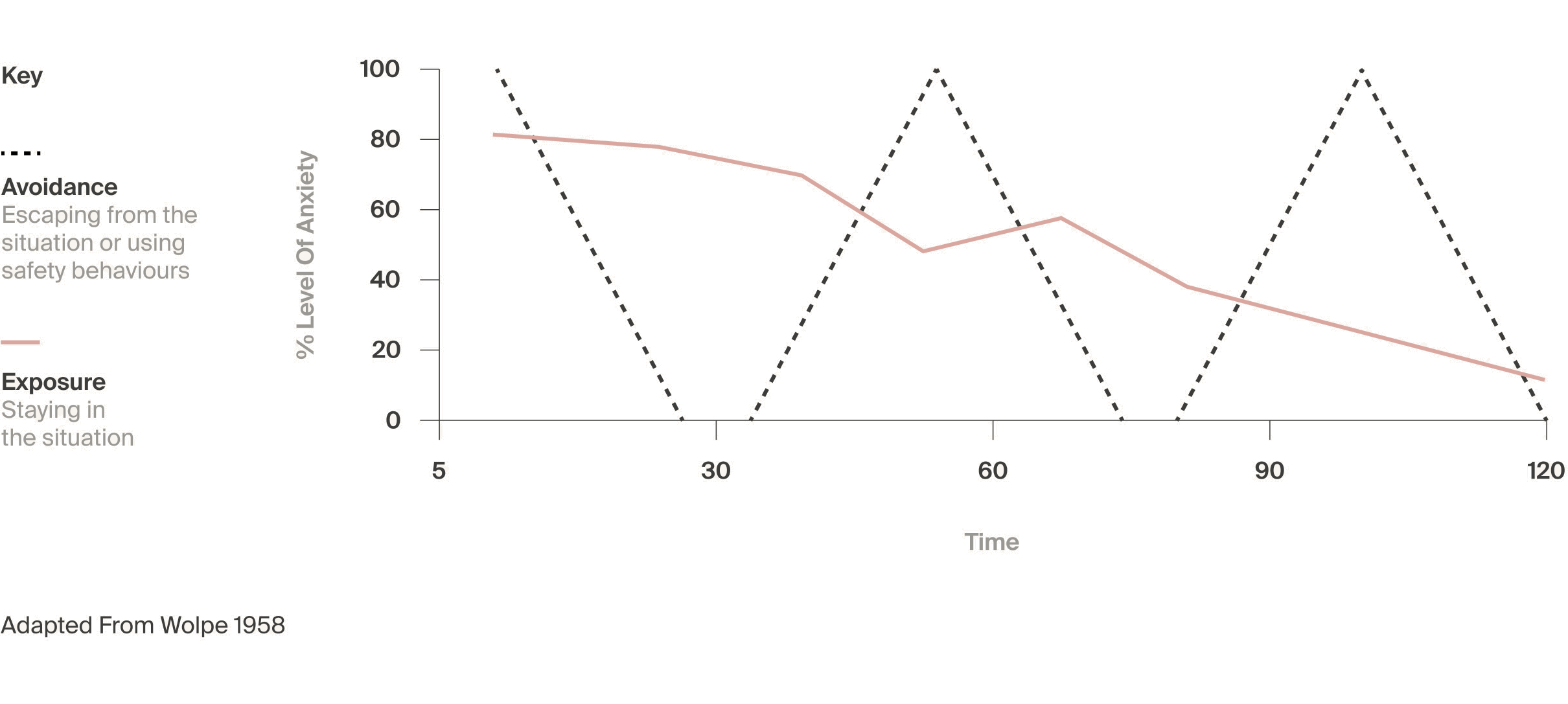
You know you have habituated when you’re bored in the presence of the threat, you’re ready for your next challenge.
An interesting discovery in the treatment of anxiety disorders was the understanding of ‘safety behaviours’ as a mechanism which keep anxiety going. There was always the big question – if nothing bad happens, why don’t we update our anxious predictions? Why such impending doom around a spider even though the worst arachnophobia scene has never actually played out for me? This is where safety behaviours come in. We do something to help us manage our anxiety – always with the goal of avoidance – often quite random and unrelated like listening to music on a tube, always drinking water, playing a game on my phone – fine, harmless who cares – EXCEPT we get this odd thing happening where we start to think we were only ok in our anxiety inducing situation, because we did something to keep ourselves safe. We just about got away with it. We didn’t reveal our REAL self, or sit in the feelings, or acknowledge our anxiety with kindness. All of which take bravery and is helpful.
To get the benefits of exposure therapy we need to lean in and be really brave, dropping our safety behaviours – those things we do to keep ourself feeling safe. We might find we are ok, just the way we are – just the ways things are. And if things don’t go that well – but we’re not in actual danger – it’s good for confidence to know that we can tolerate that.
There’s a short story I tell my patients somethings that’s popular CBT folklore. It helps illustrates how safety behaviours can be maintained, become quite stressful crutches and prevent us from learning that we would have been ok anyway – which would be more conducive to reducing our anxiety over time.
There’s a man down the road at train station, every day he throws salt up and down the railway tracks and then rushes off to work. One day I stop him. “Why do you do that?” I ask. “It’s to keep the crocodiles away” he replied. “But we don’t have any crocodiles around here”, I protest. “Exactly! You’re welcome!”
How do you think this man might feel about being persuaded to experiment with dropping this ‘safety behaviour’? It would take a LOT of persuading. If no crocodiles came on day one, he wouldn’t be fully assured. He’s need repeated exposure, without the use of safety behaviours (we don’t want him developing another crutch which stops him – over time – from relaxing. He’s safe anyway).
So exposure and habituation only works if you’re not using safety behaviours. These vary as much as people do. If you’re in a social situation, exposing yourself for social anxiety purposes, counting backwards from a hundred, rubbing a lucky stone, preparing excessively or worrying about how you’re coming across could count as safety behaviours. They might seem harmless – only distracting to various degrees – but actually they prevent you from getting lost in the moment with all your awareness. So you’re not open to positive feedback from the world, with which you might find you can update some of your anxious predictions. But what’s needed really is just time for your adrenaline levels to drop back down, your nervous system to settle and for this to happen in the presence of the thing that you fear. You can form new associations. You’ll need to do this regularly and repeatedly or you’ll think it’s a fluke.
I wonder if there’s anything you’re avoiding that you might want to consider facing? Could you bring in the principals of exposure and habituation if so, and do this in a graded way? Good luck! We are here to help with this if you need us.